From Enticing Entrées to the Secret Sauce
On July 20, 1969, Apollo 11, the first crewed lunar landing in history, touched down on the Moon to the applause and elation of the hundreds of thousands who worked to get it there. NASA used the Apollo Guidance Computer on both the Command Module and the Lunar Landing Module. It contained groundbreaking technology for its time, with 2 kilobytes of RAM and 36 kilobytes of permanent storage.
Today, my Apple Watch has over two million times the computing power used to land on the Moon. Decades of steady compounding turned room-sized computers into something that fits on my wrist. The same principle can also make time work for you.
Last week in From Dynamic Dinnerware to Enticing Entrées, we piled your ceramic plate high with a diverse menu, ranging from new-age stir-fry to old-school lasagna, and discussed the differences between America’s three major stock indexes. This week, we’re talking about the seasoning and secret sauce that bring the entire dish together: compounding.
How it Works
Often called the eighth wonder of the world, compounding is the process of reinvesting earnings, such as interest or company profits, so that they generate their own earnings. It creates a snowball effect where money grows on top of itself and accelerates over time.
Your dollars may not seem like much today, but given years or decades, they grow exponentially. Eventually, the growth from compounding can outpace what you’re even contributing to savings. Similar to how today’s computers are now advanced enough to begin writing their own code through cutting-edge AI systems.
Growth in the Real World
Michael Phelps and Kobe Bryant didn’t wake up one day as world-class athletes. Through daily training and relentless focus, they grew their skills from local standouts to national champions and ultimately global icons representing their sports.
The same goes for learning. My brother just started high school, and when he told me about his English class, I held back laughter, not at him, but at the remarkable growth that occurs between ninth grade and college. A freshman high-schooler may struggle to write a one-page essay, while a college junior wrestles with a ten-page paper (ask me how I know!) What feels overwhelming now will one day seem simple, like the shorter assignments that once felt impossible to breeze through.
How Your Money Doubles
There’s a quick way to estimate how long it takes to double your money: the Rule of 72. Divide 72 by your annual rate of return.
3 percent → 24 years
6 percent → 12 years
8 percent → 9 years
10 percent → about 7 years
12 percent → 6 years
At the S&P 500’s historical 10 percent average, your money doubles roughly every seven years. At the Nasdaq’s higher historical growth rate of about 13 percent, it doubles in just over five years.
Investing $100 in the S&P 500 might feel slow at first. For the first two decades, it crawls. But by the later years, each year’s growth equals nearly ten times your original investment—even if you never add another cent.
The Power of Time
As a college student or young professional, money is scarce, but time is abundant. If you wait until 40 to start investing, you might have more income, but with only twenty years to grow, each dollar compounds into just under $7 by age 60. Start at age 30 and you’ll reach about $17 per dollar invested. Start at age 20, and you’ll have roughly $45 for every dollar socked away.
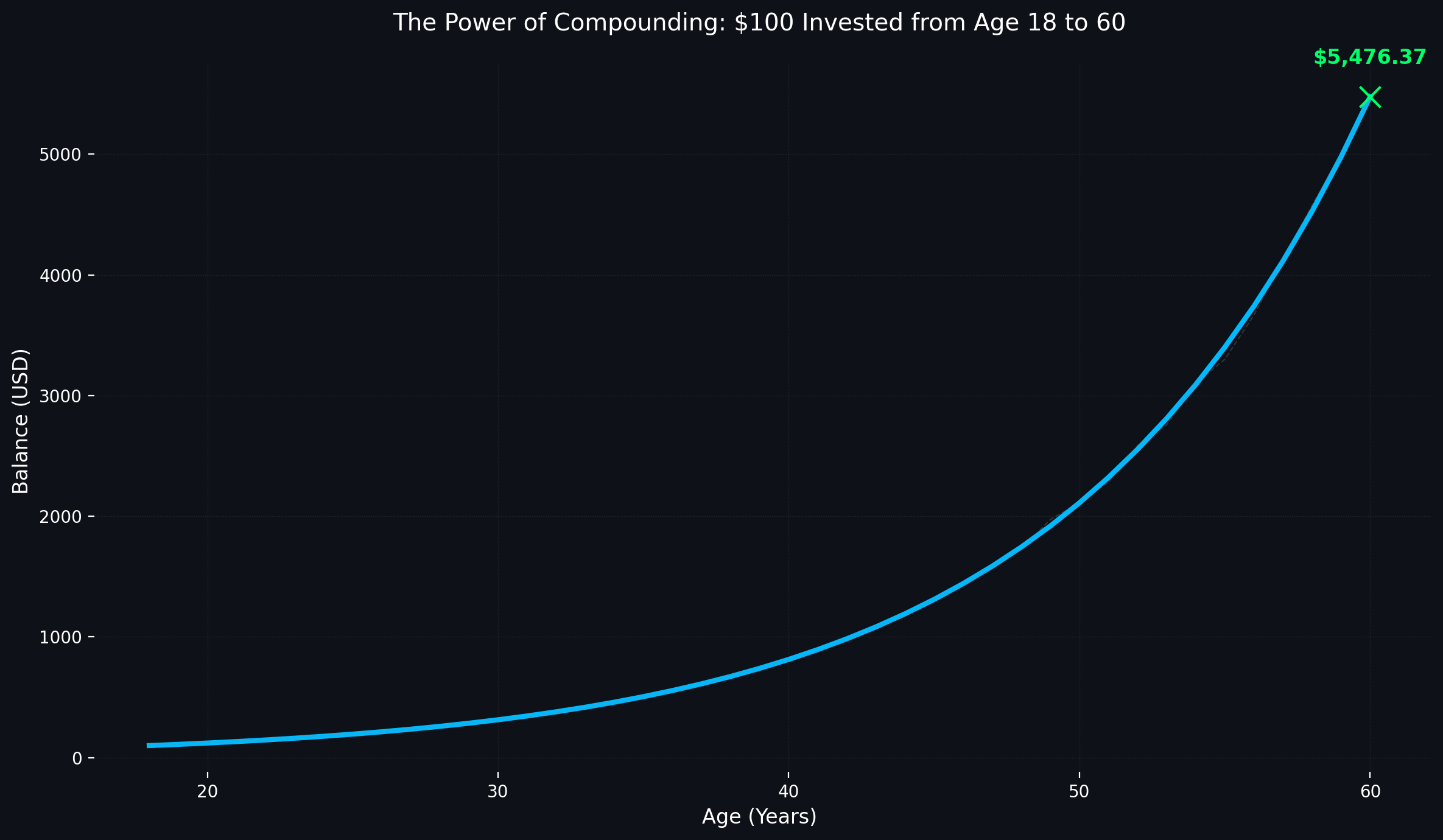
The Power of Compounding: $100 Invested from Age 18 to 60 |Free Compound Interest Calculator
Combine the consistency of the 25-500 Plan, the tax efficiency of a Roth IRA, and the long-term averages of the S&P 500, and the secret sauce of investing becomes clear. Starting early makes you a millionaire of time. It turns a handful of dollars into the millions you’ll need—and want—as your most valuable asset, time, inevitably slips away.
The Sluggish Start
The first five to ten years will feel painfully slow. Your $100 might become $110, then $221, and you’ll wonder if it’s even working. But those years are the foundation. Compounding means that the most significant gains typically occur in the final stretch.
It’s a slow-cooked sauce. It may look the same for hours, but eventually it thickens into the flavor that brings the entire meal together.
You’ve let the sauce simmer. Now it’s time for dessert, the icing on the cake: cashback rewards and other micro-incomes.
